
Assessment 009 | The Managed War
The gap between what you are told and what is happening is not a failure. It is the strategy.

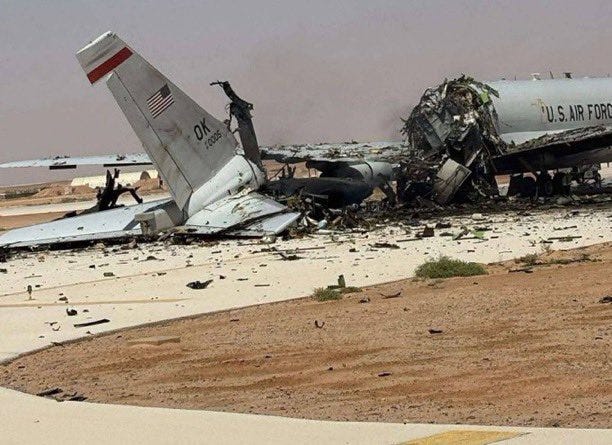
The headline said damaged.
The photograph shows an aircraft in pieces on the tarmac at Prince Sultan Air Base in Saudi Arabia. The tail markings are visible. The US Air Force markings are visible. The rear fuselage where the radar dome and surveillance systems are housed is gone. Air and Space Forces Magazine, the official publication of the Air Force Association and the most credible specialist outlet for US Air Force matters, reviewed the image and wrote that the extent of the damage likely renders the aircraft unrepairable. Then they published that finding under the word damaged.
That is not a typo. That is a choice.
The aircraft was an E-3 Sentry AWACS. That stands for Airborne Warning and Control System. The system that sees the battlefield and tells every other aircraft where to go and what to shoot. The US Air Force fleet has dwindled to 16. One of them is gone. Not damaged. Gone. And the American public was given one word to describe it while the specialists who know exactly what that word means used their own article to tell you the word was wrong.
This is not an isolated incident. It is the most visible example of a system that has been operating since February 28. A system designed not to inform the public about this war but to manage what the public understands about it. The distinction matters because one of those is journalism and one of those is something else entirely.
The gap between those two things has been watched for thirty days. What follows is what I found.
The Toll
The AWACS is one entry in a ledger that has not been shown to the American public in full.
Three F-15E Strike Eagles were shot down on March 2. Not by Iran. By a Kuwaiti fighter jet in a friendly fire incident during the opening phase of strike operations. All six crew members ejected safely. Losing three fixed-wing aircraft in a single incident is the largest single-day loss of that class since the Gulf War in 1991. The cause was friendly fire. The aircraft are still gone.
A KC-135 Stratotanker crashed in western Iraq on March 12, killing all six airmen aboard. A second KC-135 had its tail severely damaged in the same incident. These are the aircraft that keep fighter jets in the air over Iran. Losing them is not a footnote.
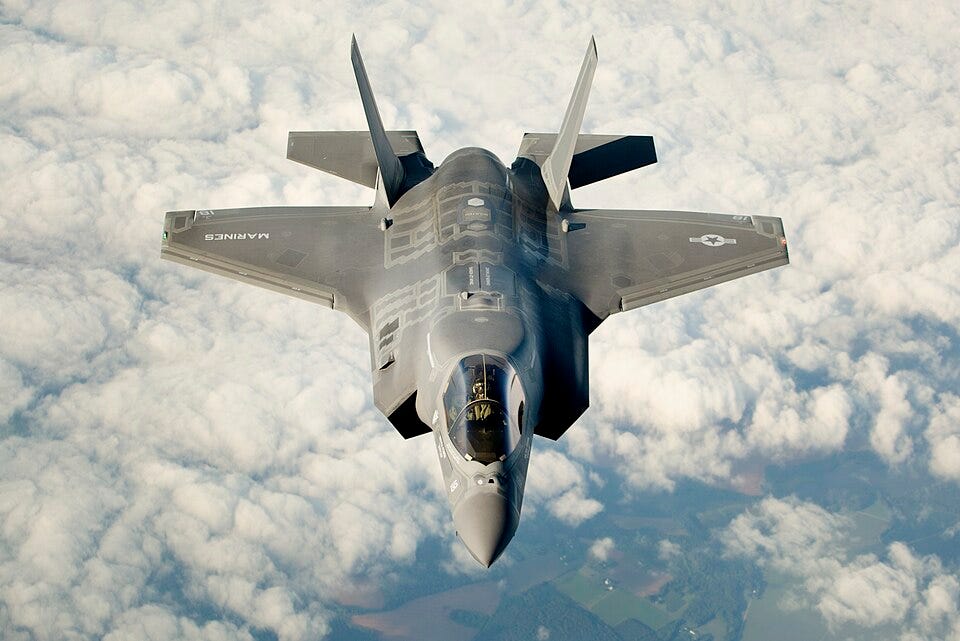
On March 19, a US Air Force F-35A made an emergency landing after being struck over Iran. This was the first time in history that a fifth-generation stealth fighter had been hit by enemy fire since the aircraft entered combat operations in 2018. The pilot suffered shrapnel wounds. The IRGC released footage purporting to show the intercept using a passive infrared sensor system. Stealth aircraft are designed to defeat radar. They are not designed to defeat heat signatures. Iran has passive infrared systems. They used one successfully against the most sophisticated aircraft in the American inventory. Defense Secretary Pete Hegseth had declared Iran’s air defenses flattened that same morning.
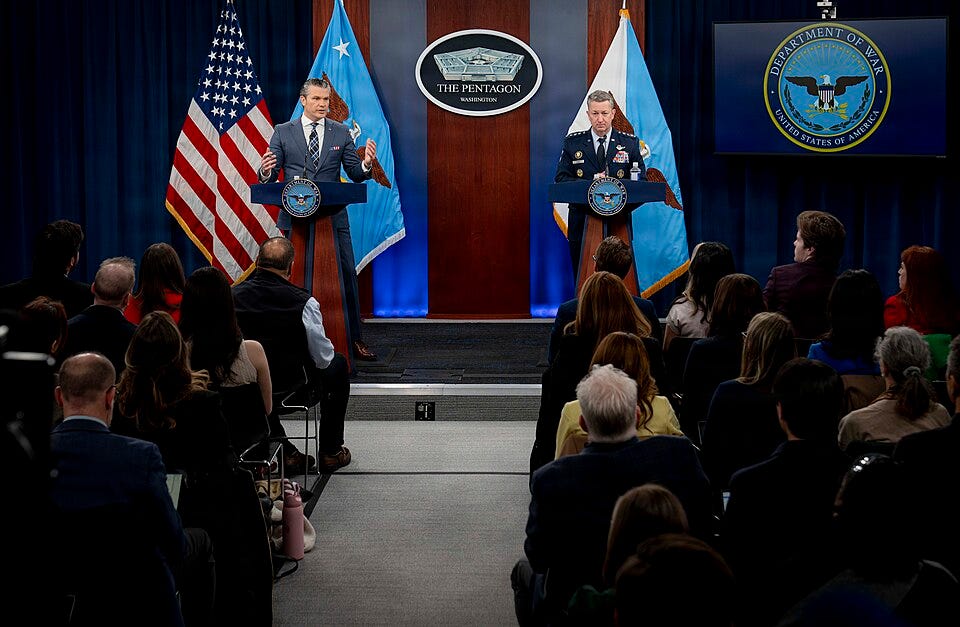
CNN reported the contradiction. But no reporter has confronted Hegseth directly at a Pentagon podium with his own words from that morning. They could not have done so that day. The F-35 story broke after he left the podium. No subsequent briefing has produced that direct confrontation. The structure of the briefing room helps explain why. Traditional outlets are seated in the back and generally ignored while Hegseth calls on a handpicked press corps in the front rows. The Pentagon barred photographers entirely after published images were deemed unflattering. A federal judge ruled the arrangement unconstitutional viewpoint discrimination. Hegseth is appealing. The gap between what was said that morning and what happened that afternoon remains on the record. Uncontested. Unaddressed. Exactly where the administration left it.
The official US Air Force count acknowledges approximately 20 aircraft damaged or destroyed in 30 days. Twelve-plus MQ-9 Reaper drones lost. One F-35 struck. One E-3 AWACS operationally destroyed. Three F-15Es gone. Two KC-135s lost or damaged.
In the entire Iraq war from 2003 to 2011, the US lost approximately 24 fixed-wing aircraft across eight years of operations. In Afghanistan, zero manned fixed-wing aircraft were lost to enemy action across the entire conflict. The critical difference is that Iraq in 2003 had no functioning air force. Afghanistan had no meaningful air defense. In 30 days of Operation Epic Fury the confirmed fixed-wing losses already stand at seven aircraft including one operationally destroyed AWACS and one F-35 struck by a system stealth was never designed to defeat. The administration overseeing those losses told you Iran’s air defenses were flattened. The math is not complicated. The threat environment Iran presents is categorically different from every conflict US forces have fought since Vietnam. The language being used to describe it is not.
The word damaged is doing a great deal of work in this conflict. It is doing more work than the public has been allowed to notice.
The Word They Chose
This conflict has been called a military operation since the first bomb fell on February 28.
Not a war. An operation.
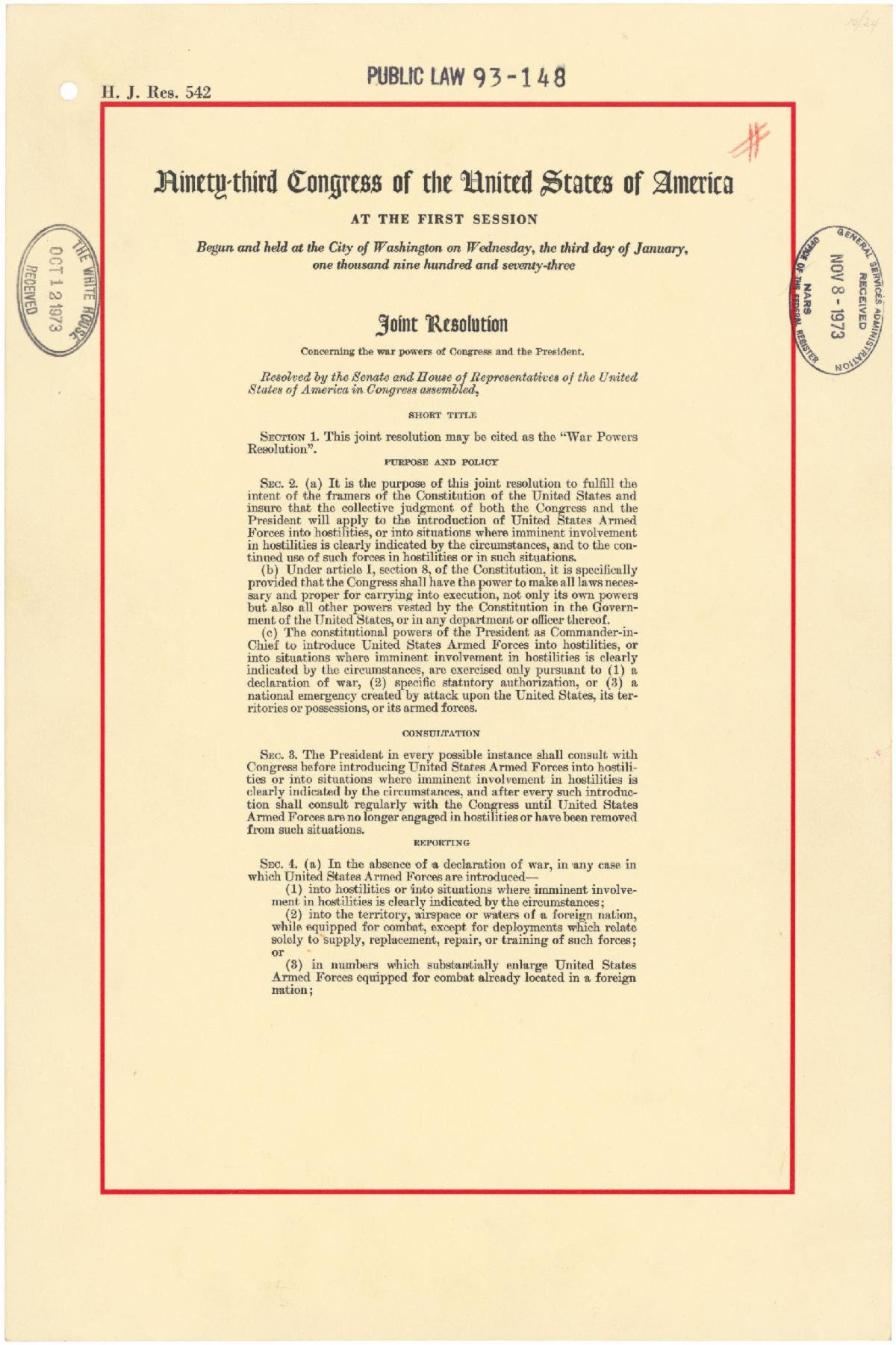
That word was not chosen by accident. Under the War Powers Act, a president must notify Congress within 48 hours of committing forces to hostilities and obtain authorization within 60 days or face mandatory withdrawal. The word war triggers specific legal mechanisms, specific oversight requirements, specific accountability structures that the administration has spent thirty days carefully avoiding.
Three independent polls confirm majority American opposition to this conflict. Pew Research at 59 percent wrong decision. Quinnipiac at 54 percent opposed among registered voters. AP-NORC confirming the same direction. The administration launching a conflict the majority of Americans oppose would face immediate and sustained congressional pressure if the legal framework required congressional engagement. The word operation manages that pressure the same way the word damaged managed the AWACS story. Precision in language as a tool of precision avoidance.
This is not speculation about motive. It is reading the behavioral evidence. When an administration chooses language that specifically forecloses the oversight mechanisms designed for exactly this situation, the choice of language is the message. They know how unpopular this is. They know the legal footing is contested. They fear accountability and the word operation is how they are trying to avoid it.
When you call a war an operation you are not just managing terminology. You are telling the public that their representatives do not need to be asked. Thirteen Americans are dead. Over three hundred are wounded. The public has not been asked.
The Press That Stopped Asking
In the Iraq and Afghanistan era, reporters embedded with units. Cameras were at Dover for returning casualties. The Abu Ghraib photographs existed because a soldier took them and a journalist published them despite institutional pressure not to. The Downing Street Memo existed because a source took the risk of providing it and a publication took the risk of printing it. Those mechanisms were imperfect and incomplete and they still produced more accountability than anything available today.
There are no embedded journalists with the 31st MEU. No reporters were present when the AWACS was struck. No cameras were at Prince Sultan when the missile hit. The information that exists about those events arrived through two channels. Either CENTCOM chose to release it or specialist outlets obtained it through anonymous officials who chose to let it out. Neither of those is journalism. Both are managed disclosure with a byline attached.
The press corps covering this war is not corrupt. The mechanism is more precise and more durable than corruption. The documented briefing room structure tells you everything about how accountability has been foreclosed. A reporter operating inside that structure faces a rational calculation every time they consider pressing on a contradiction. Access is the currency. Losing it ends the beat. The aggregate result of thousands of individual rational decisions is a press corps that has collectively decided access is worth more than accountability.
When the penalty for asking the right question is losing the ability to ask any questions, the press stops asking the right questions. That is not journalism failing. That is journalism being systematically dismantled while calling itself access.
The American public deserves better than a press corps that takes what is provided, reports it without contest, and calls it coverage. Every day that happens is another day the gap widens and nobody in the room is paid to notice.
A Note on This Publication’s Record
I assessed the infrastructure targeting doctrine as falsified on Day 8. The official line was that the campaign was working. I assessed the Kurdish ground operation as real on Day 3 when the White House was publicly denying it. Published the overlap thesis on Day 28 arguing that diplomacy and military escalation were running simultaneously without mutual constraint. Within 24 hours the Pentagon confirmed ground operations planning to the Washington Post.
I cite this not to congratulate myself. I cite it because the reader finding this piece for the first time deserves to know that the distance between what The Omission has documented from open sources and what the governments prosecuting this war have told the public is not a rounding error.
It is a system. And it was built before the first strike landed.
The Why
The Behavioral Override has been applied to Iran throughout thirty days of assessments and dispatches. The doctrine is simple. When stated policy contradicts behavioral evidence, behavioral evidence governs every time. I have applied it to individual US decisions throughout this conflict.
I have not applied it to the decision to go to war itself. So I’m doing that now.
The stated policy is that this was a defensive military operation to eliminate imminent threats and protect American lives.
Here is the behavioral evidence.
The Omani foreign minister confirmed on February 27 that Iran was willing to make concessions, that progress was significant, and that agreement was within reach. A British senior adviser sat in on the final round of talks and assessed there was a good chance of reaching agreement. Trump was told. The bombs fell the following morning.
Pentagon briefers told congressional staff within 72 hours of the first strike that Iran was not planning to strike US forces unless attacked first. The imminent threat predicate was contradicted by the same government that used it as the legal justification for the war.
Netanyahu made a final phone call to Trump less than two days before the strikes arguing that intelligence showed a fleeting window to kill Khamenei. Multiple sources confirm Trump had already approved the concept of a military operation before that call. The intelligence window provided the timing. The decision had already been made.
The Mossad regime change plan, Kurdish invasion, internal uprising, rapid regime collapse, was presented to senior Trump administration officials in January 2026, six weeks before the first bomb fell. The force posture, two aircraft carriers, Marine Expeditionary Units, 82nd Airborne deployment, was assembled before the diplomatic track concluded.
None of those are reactions to an imminent threat. All of them are preparations for a decision already made.
The Analysis of Competing Hypotheses is run on every major analytical question here. The method requires ranking all explanations against all evidence and eliminating by falsification not preference. The hypothesis with the fewest inconsistencies survives.
Hypothesis one. The war was genuinely reactive to an imminent threat. Inconsistent with the pre-positioning timeline, the diplomatic breakthrough not taken, the Mossad plan presented six weeks before the strikes, and the predicate contradiction within 72 hours. Does not survive.
Hypothesis two. Netanyahu pushed Trump into a war Trump did not want. Inconsistent with Trump having already approved the concept before Netanyahu’s final call and with the US force posture assembly preceding that appeal. Does not survive in its simple form.
Hypothesis three. The war was a convergent strategic decision built around aligned interests, provided with a legal predicate after the decision was made, and surrounded by an information architecture designed to prevent the public from performing exactly this analysis. This hypothesis is consistent with every piece of behavioral evidence available across thirty days. It survives.
What were those aligned interests? Israel wanted Iran’s military capacity and regional influence permanently destroyed. The United States wanted control of the Strait of Hormuz, through which 20 percent of global oil flows and through which China receives a third of its energy. Saudi Arabia wanted Iran removed as the dominant regional power. The convergence of those three objectives produces a strategic logic that the stated predicate of imminent threat does not begin to explain.
This is not a theory. This is the Behavioral Override applied to Washington with thirty days of documented behavioral evidence. The behavior describes a war planned around strategic objectives and provided with a justification afterward. That is not unprecedented. It is documented American history. The Downing Street Memo confirmed that the intelligence in Iraq was being fixed around the policy. The decision preceded the justification. The war launched. No weapons were found.
The difference here is that the gap is visible in real time. Before the documents are declassified. Before the memoirs are written. Before the official version hardens into history.
The American public deserves to know why the rising costs crippling their economy, the global supply chain that determines the price of everything on their shelves and the fuel in their tanks, was placed at risk. They deserve to know what was so important that a diplomatic agreement confirmed as within reach on February 27 was set aside the following morning. The Omani foreign minister had just confirmed Iran was willing to make concessions. A British senior adviser assessed a good chance of reaching agreement. Trump was told. The bombs fell anyway.
They deserve to know whether the reason their sons and daughters are in a theater where an F-35 can be struck and an AWACS destroyed is the reason they were given. The behavioral evidence says it is not. And the concerns of those who decided this was worth doing have not been paid for by the people who decided it.
The managed war continues. The gap between what is said and what is happening is widening. And the architecture designed to prevent the public from seeing that gap is working exactly as intended.
Until it doesn’t.
Analytical Methodology
This publication applies structured analytic techniques used in intelligence analysis and open-source investigations, including Analysis of Competing Hypotheses (ACH), systemic analysis frameworks, probability and confidence standards derived from UK Joint Intelligence Committee (JIC) methodology, deception-awareness concepts such as Maskirovka, Key Assumptions Checks (KAC), and geolocation techniques used in modern OSINT investigations.
Confidence levels are stated explicitly:
CONFIRMED — Three or more independent, non-aligned sources supported by physical evidence.
ASSESSED — A single credible source consistent with established patterns or corroborating indicators.
CLAIMED — A single, possibly aligned source with no independent corroboration.
All information used in this analysis is derived from open-source material. This publication is independent, with no government affiliation and no institutional funding.
Does anyone else not buy the "friendly fire" story on those F-35s?
What, ONE Kuwaiti fighter went Red Baron on all three?
Smells like the same BS.
The press corps is also corrupt. Trading access in exchange for not asking hard questions is the very definition of corruption. Today's media only care about getting the biggest engagement numbers. No one is trying to break a difficult story because the public needs to know. And such investigative journalists as do exist are very happy to tell you about how heroic and brave they are and how wicked everyone with power is, without ever uncovering the next Abu Ghraib.